
Earth Knowledge Corporate

Move beyond regulations. Inject climate intelligence into everyday operations and supply chain decisions.
Corporate Climate Disclosure Has Passed a Tipping Point.
“While the United States’ long-awaited disclosure rule, issued in March 2024, was less ambitious than originally proposed, it still signaled a critical shift from voluntary practices to mandatory requirements. It cemented for the world’s largest economy that climate risks can be financially “material” — and that when they are, they must be reported like any other risk to a company’s bottom line. Once all pending disclosure rules are in force, we estimate that they will cover nearly 40% of the world’s economy.
But it’s not just that: Companies have long seen the global patchwork of disclosure frameworks as an impediment to reporting. But these are consolidating as regulators develop a better understanding of how climate change affects business performance. This is making reporting standards clearer and thus easier for firms, dispelling one of the key arguments against climate disclosures.
The bottom line is that climate disclosure has reached a tipping point. Mandates are becoming the norm. And where differences lie between more stringent and ‘weaker’ mandates, current trends point toward the stronger rules pulling ahead.”

Compliance without the complexity.
Climate and nature regulations are generating a new wave of compliance obligations for corporations. In fact, the speed and volume of regulations is incredibly complex. To reduce complexity, Earth Knowledge combines climate and natural-capital data and information into one simple, easy to understand data platform. Regardless of the geography or regulatory requirements, Earth Knowledge will address your compliance needs.
Whether it’s TCFD, TNFD, CSRD, ESRS or a new emerging regulatory framework, Earth Knowledge can help you stress-test and create a compliance roadmap.
Mitigate risks. Measure resilience.
Climate and nature changes are occurring daily, impacting businesses globally. Earth Knowledge data and information enable ready discernment of trends and patterns therein.
Whether it’s temperature, precipitation, wildfire, flood or any of the 50+ key indicators we report, opportunities exist for clients to identify and mitigate risk and adapt operations.
- Supply chain vulnerability
- Real estate site selection
- Investment strategies
- Single point of failure analysis
- Operational resilience and efficiency
- Multiple alternative futures and land use change simulations
Combined with Earth Knowledge Insight services, we couple this data with insights, intelligent action plans and measurement metrics to ensure ongoing success.

Richard Peers, Founder Responsible Risk Solutions & Former Senior Director, WW Financial Services, Microsoft
“In 2020 Larry Fink stated that “Climate risk is investment risk”. In the intervening years it has become apparent that Nature and Climate are two sides of the same coin. Responding to TNFD and CSRD the public and private sectors are struggling to understand their dependencies on Nature and report their double materiality disclosures. Earth Knowledge applies system thinking and their digital twin of the Earth provides the most comprehensive way of assessing, mitigating and adapting to climate/nature risks and opportunities.”
Tailored for every business
Physical Asset Risk
Portfolio Analysis
Operations & Value Chain
Earth Knowledge Twin for Corporations
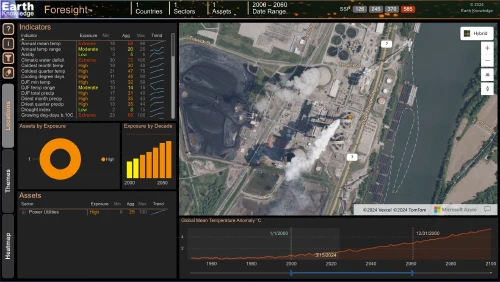
Industry-leading resolution
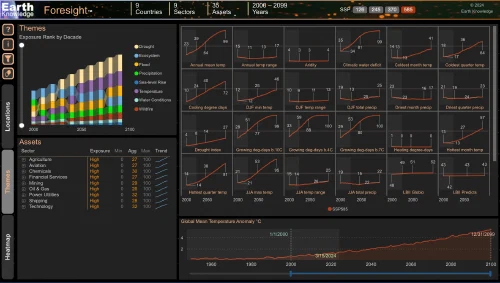
Visualize climate impact
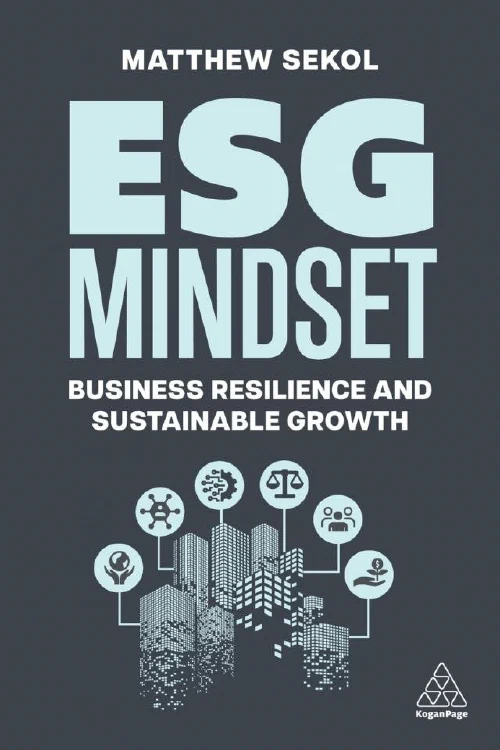
As featured in ESG Mindset by Matthew Sekol:
“In ESG Mindset, I develop a mindset for considering material ESG risks and opportunities for companies. In the chase for endless carbon emissions and mitigation, climate risk and adaptation are overlooked, and this is right where Earth Knowledge provides significant value”
Our climate & nature partners








Comprehensive sector-specific insights with Earth Knowledge Twin
Construction: Drought & Water Availability
A cement manufacturing company might face challenges and cost increases with a rising drought index due to water being a critical component in the cement-making process. Water scarcity can lead to production delays or increased costs as water needs to be sourced from farther away. Additionally, drought conditions can lead to stricter water usage regulations, forcing the company to adopt more water-efficient technologies or processes, which could entail significant capital investments.
Energy & Utilities: Cooling Degree Days (CDD)
Increased CDDs: A rise in CDDs, typically during hotter and/or longer summers, leads to increased demand for air conditioning and cooling systems in homes and businesses. This surge in demand can strain the energy grid, requiring utility companies to ramp up production and possibly invest in additional infrastructure to meet peak loads. Higher CDDs can also lead to increased revenue due to higher electricity usage, but this is often accompanied by challenges like managing load distribution and maintaining infrastructure.
Decreased CDDs: Conversely, a decrease in CDDs, indicating milder temperatures, results in lower demand for cooling. This can lead to reduced revenue for utility companies. However, it may also lower operational costs and lessen the strain on the energy grid. It gives these companies an opportunity to perform maintenance and upgrades without the pressure of high demand.
Pharmaceuticals / Bioprospecting: Species Richness
The pharmaceutical industry often relies on biological resources for drug discovery and development, a process known as bioprospecting. A decrease in species intactness can lead to the loss of genetic diversity and potentially valuable undiscovered compounds that could be used in new medications. This loss can limit opportunities for innovation and drug development, affecting the long-term sustainability and profitability of pharmaceutical companies.
Retail & Consumer Goods: Temperature of Hottest Month
A change in the temperature of the hottest month can significantly affect companies in the retail and consumer goods sectors. For example, if the temperature of the hottest month shifts to a period traditionally associated with lower temperatures, this could disrupt sales patterns for seasonal products. Companies might find themselves with excess inventory of summer products like air conditioners, swimwear, or cold beverages during a period when demand is unexpectedly low. This mismatch can lead to increased holding costs, markdowns, and reduced profit margins. Conversely, there could be a shortfall in supply during the new hottest month, leading to lost sales opportunities. To adapt, companies might need to revise their product sourcing and inventory management strategies, potentially incurring additional costs and impacting the asset value of inventory and supply chain infrastructure.
Agriculture: Species Intactness
Declines in species intactness, particularly of pollinators like bees and butterflies, can directly impact agricultural productivity and crop yields. Many crops depend on insect pollination, so a reduction in pollinator populations can lead to decreased fruit, vegetable, and seed production, increasing costs and reducing income for farmers and agribusinesses. This can also lead to higher prices for consumers and potentially affect the global food supply.
Tourism: Wildfire Index
Tourism Planning and Customer Safety: For businesses in the tourism and hospitality industry, such as hotels, resorts, and travel agencies, a high Wildfire Index can significantly impact operations. These businesses rely on the attractiveness and safety of their destinations to draw visitors. A high wildfire risk can deter tourists, leading to cancellations and reduced bookings. Additionally, these businesses must prioritize the safety of their guests, which can involve emergency preparedness plans, evacuation procedures, and constant monitoring of wildfire alerts.
Seasonal Revenue and Insurance Costs: In regions where tourism is highly seasonal, a high Wildfire Index during peak seasons can have a substantial financial impact. It can lead to a decrease in visitor numbers, affecting the revenue of businesses that depend on peak-season traffic. Furthermore, higher wildfire risks can increase insurance premiums for these businesses, adding to operational costs. It may also necessitate additional investments in fire prevention and safety measures to protect properties and ensure the safety of guests.

Earth Knowledge natively models cascading impacts across different earth systems. See how changes in one earth system interacts with other subsystems to reduce or amplify the change.

Learn more about our corporate solutions
We understand the unique challenges faced by corporates and financial institutions in integrating environmental considerations into their strategic decisions. Our solutions offer comprehensive, authoritative insights into climate and nature-related physical risks.
To learn more;