
Cascading Climate Risk: What Leaders Need to Know and Do
By Dr. Don Wuebbles, Director of Climate Science
There is growing evidence that our changing climate is exacerbating extreme weather, compromising global food and water security, accelerating the spread of disease, and fueling mass displacement.
Clearly, none of this is good for the public interest or for business.
Yet there are meaningful ways to anticipate and mitigate these risks as well as seize new opportunities on our changing planet.
This is what Earth Knowledge helps organizations do, thanks to the most comprehensive planetary intelligence platform—providing integrated weather, climate, and earth systems insights from days to decades from now.
Earth Knowledge's Systems of Systems approach analyzes numerous Earth system components across varying spatial and temporal scales to evaluate the cascading effects in climate-hydrologic-ecologic systems.
This comprehensive approach assesses historical and likely future changes over a 200-year period, drawing on over 100 years of the historical record and considering four possible climate futures. By tracking the state of the science, our analyses can help identify potential tipping points.
Here’s why access to these insights is so important for today’s leaders.
Climate Change Leads to Cascading Events
A major reason for the accelerating impacts on humanity from changes in Earth’s climate is the cascading chain reaction of numerous events at different spatial and temporal scales triggered by an initial change in the system driven by the changing climate.
As one event occurs, it sets off other events that may amplify the initial impact. For example, the melting of sea and land ice in the Arctic increases the absorption of sunlight by darker land and ocean surfaces, which in turn accelerates warming and further ice melt, creating a self-reinforcing loop. In time, such cascading events can lead to irreversible tipping points.
Many of the major global biophysical systems on our planet, such as the Amazon rainforest or the Greenland ice sheets, are deeply interconnected with other systems that affect the climate we are used to. When one of these biophysical systems collapses, it alters environmental conditions—such as freshwater runoff, regional temperatures, or ocean currents—thereby destabilizing adjacent systems.
Climate Tipping Points
A climate tipping point is a critical threshold where a change in the climate pushes a biophysical system into a completely new state that is essentially irreversible within reasonable timelines of the human experience. Armstrong McKay et al. (2022) define tipping points as occurring when a change in part of the climate system becomes self-perpetuating beyond a warming threshold as a result of asymmetry in the relevant feedbacks, leading to substantial and widespread Earth system impacts.
When crossing one threshold triggers subsequent, compounding thresholds—creating a domino effect of systemic failure—it is known as a cascading event or, in the case of tipping points, a tipping cascade.
Several major potential tipping points are currently recognized (e.g., Lenton et al. 2008, 2025; Brovkin et al. 2021; Armstrong McKay et al. 2022), and more tipping points may be determined as the climate continues to evolve. For example, Armstrong McKay et al. (2022) identify nine global “core” tipping elements that contribute substantially to Earth system functioning and seven regional “impact” tipping elements that contribute substantially to human welfare or have great value as unique features of the Earth system.
Consequential Tipping Points Include:
- Greenland and West Antarctic Ice Sheets: The Earth’s major ice sheets have already seen significant melting over the last century, but at some point, the global change in temperature will cross a threshold that will trigger loss of almost all of this ice. This melting is already accelerating, and while it could take several hundred years, crossing this threshold would commit the globe to severe sea-level rise lasting for many centuries.
- Arctic Sea Ice: Extensive loss of Arctic sea ice during the summer months has already occurred over recent decades. Once summer sea ice extent drops below a certain threshold, reinforcing feedback loops make it difficult for the ice to reform during the winter. While melting Arctic sea ice does not contribute to sea level rise, the extensive loss of sea ice can destabilize the polar vortex and alter the jet stream, leading to more extreme weather events globally. This loss of sea ice also destabilizes Arctic ecosystems.
- Atlantic Meridional Overturning Circulation (AMOC): Freshwater from melting sea and land ice in the Arctic threatens to radically slow this vital ocean heat conveyor belt and perhaps even shut it down. A collapse would cause severe winters in northwest Europe, shift global rainfall patterns, and radically impact food security worldwide.
- Amazon Rainforest: Prolonged droughts, severe El Niño events, and deforestation are pushing the Amazon toward a threshold where it could transition into a dry savanna. This dieback would likely have major effects on weather patterns, especially in South America, and would also release massive amounts of carbon into the atmosphere, further exacerbating global climate change.
- Boreal Permafrost: Rising Arctic temperatures are causing permafrost to thaw, albeit currently at a slow rate. Permafrost has acted as a frozen freezer for thousands of years' worth of dead, undecomposed organic matter (plants and animals). As the climate warms, the permafrost thaws, allowing microbes to decompose the organic material, releasing potentially large greenhouse gas emissions of carbon dioxide (CO2) and methane (CH4) into the atmosphere, driving further warming and resulting impacts.
- Warm-Water Coral Reefs: Coral reefs are already under stress and are highly sensitive to further thermal stress in a warming climate. Crossing temperature thresholds could lead to mass bleaching and ecosystem death, stripping coastlines of protection and destroying habitats for roughly 25% of all marine species.
- Mountain Glaciers: Glacial systems (such as the icefields in Alaska and the Andes) are crossing tipping points that lead to irreversible retreat, altering regional water supplies and increasing local flood risks.
Scientists throughout the world have been investigating ways to predict climate tipping points and their resulting impacts. However, the impacts have remained difficult to fully capture with accuracy because of the complexity and dynamics of the interconnected Earth systems involved.
Nonetheless, the increased attention has led to significant increases in knowledge on tipping points. For example, Armstrong McKay et al. (2022) examined the current understanding of temperature thresholds and time scales (along with uncertainty ranges) for tipping points.
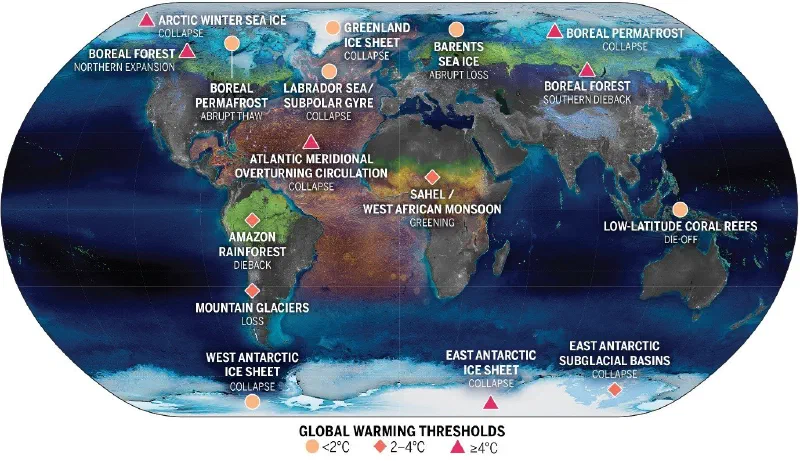
Their findings are eye-opening, suggesting that the temperature thresholds for several important tipping points have already been exceeded or will be within the next few decades (see Figure 1 for a summary).
Note that recent studies (e.g., Rath et al. 2026) indicate that globally averaged temperature change on climate time scales will reach 1.5°C within the next few years and that 2°C will likely be reached within the next two decades.
What Studies Reveal About Warming Temperatures in Coming Years
- The collapse of the Greenland Ice Sheet may have already begun, but 1.5°C is the central estimate for the start time (with a range of 0.8-3.0°C). It will take many centuries for the Greenland Ice Sheet to fully collapse, but once the threshold is crossed, it may not be readily stopped.
- The collapse of the West Antarctic Ice Sheet may have already begun, but 1.5°C is the central estimate for the start time (with a range of 1.0-2.0°C). The collapse of the West Antarctic Ice Sheet could contribute to significant sea level rise (as much as a meter) this century and several meters over the next century.
The collapse of the East Antarctic Ice Sheet would require a global temperature change of 5°C or higher (central value of 7.5°C and range of 5-10°C). The collapse of East Antarctica subglacial basins has a central threshold temperature of 3.0°C (range of 2.0-6.0°C). Nonetheless, while the collapse of the East Antarctic Ice Sheet is not currently a major concern, further melting will continue to add to the sea level rise.
- Die-off of low latitude coral reefs may have already started, but 1.5°C is the central estimated start time (range of 1.0-2.0°C). Potential significant effects on ocean life will likely occur within the next few decades.
- Abrupt thawing of boreal permafrost may have already begun, but 1.5°C is the central estimated start time (range is 1.0-2.3°C). Potentially significant impacts from the thawing of boreal permafrost will likely occur over the next two centuries, adding to observed global climate changes and leading to significant effects on the Arctic landscape. Full collapse would require a global temperature change of 3.0°C or more.
- Abrupt loss of Barents (Arctic) sea ice may begin as soon as 1.5°C is reached, but the central threshold is 1.6°C, with a range of 1.5-1.7°C.
- Collapse of the AMOC is estimated to occur as soon as a threshold of 1.4°C is reached, but the central value is 4.0°C, and the range is 1.4-8.0°C.
- Major loss of mountain glaciers has already begun and could become a tipping point at 1.5°C, but the central threshold is 2°C, with a range of 1.5-3.0°C.
- The threshold for natural die-off of the Amazon rainforest is 3.5°C (with a range of 2.0-6.0°C). However, there are signs that human activities may be speeding up this process.
- Dieback in both southern and northern boreal forests could begin as soon as 1.5°C is reached, but the central value is a change of 4°C, with a range of 1.4-5.0°C for southern boreal forests and 1.5-7.2°C for northern boreal forests.
These analyses set the bar for further discussions and analyses of what we should be concerned about in determining a tipping point and what it means for humanity and life on Earth. While the analyses in Armstrong McKay et al. (2022) examined each tipping point independently, they also note that feedbacks in the climate system could raise the threshold temperatures for many of these tipping points.
The bottom line.
Temperature thresholds for several important tipping points have already been surpassed or are likely to be surpassed within the next few years or decades. Reaching these tipping points will have major impacts on human society and on life throughout our planet.
While everyone should certainly be aware of the potential for tipping points to significantly affect humanity, it would be grossly premature to base climate projections on them at this time. It is important to maintain scientific credibility while continuing to update the information and scientific understanding.
For leaders who want to mitigate risk and maximize opportunity on our changing planet, it is equally important to access proven forecasts to do so.
References
Armstrong McKay, D. I., A. Staal, J. F. Abrams, R. Winkelmann, B. Sakschewski, S. Loriani, I. Fetzer, S. E. Cornell, J. Rockstrom, and T. M. Lenton, 2022: Exceeding 1.5°C global warming could trigger multiple climate tipping points.Science, 377 (6611), eabn7950. DOI: 10.1126/science.abn7950.
Brovkin, V., E. Brook E, J. W. Williams, S. Bathiany, T. M. Lenton, et al., 2021: Past abrupt changes, tipping points and cascading impacts in the Earth system. Nature Geosci., 14:550–558. https://doi.org/10.1038/s41561-021-00790-5.
Lenton, T. M., H. Held, E. Kriegler, J. Hall, W. Lucht, S. Rahmstorf and H. J. Schellnhuber, 2008: Tipping Elements in the Earth’s Climate System. Proc. Nat. Acad. Sci., 105(6), 1786-1793.
Lenton, T. M., Milkoreit, M., Willcock, S., Abrams, J. F., Armstrong McKay, D. I., Buxton, J. E., Donges, J. F., Loriani, S., Wunderling, N., Alkemade, F., Barrett, M., Constantino, S., Powell, T., Smith, S. R., Boulton, C. A., Pinho, P., Dijkstra, H., Pearce-Kelly, P., Roman-Cuesta, R. M., Dennis, D. (eds), 2025: The Global Tipping Points Report 2025. University of Exeter, Exeter, UK.
Rath, S. S., K. E. Kunkel, D. J. Wuebbles, and D. R. Easterling, 2026: Evaluating the 1.5°C or 2°C Climate Thresholds: When Could These Thresholds be Surpassed? Environmental Res. Lett., 21, 094027, DOI: 10.1088/1748-9326/ae6461.