
The Future of Travel and Tourism in Our Changing Climate
Donald J. Wuebbles
Introduction
The recently released Sixth Assessment Report (AR6) of the UN’s Intergovernmental Panel on Climate Change (IPCC 2021) brought together the science community, including many of the world’s leading earth scientists, to update how and why the climate on our planet is changing and what the future may hold. The latest IPCC assessment further strengthens what previous assessments of the science have already been telling us for several decades: Climate change is happening now and it is happening extremely rapidly throughout the world. This has been the warmest decade on record, but surface temperature is just one of many indicators of our changing climate. Certain types of extreme weather events – such as heat waves and heavy precipitation – are increasing in severity and frequency, leading to droughts in some locations and floods in others. Sea levels are rising as the oceans warm and land ice melts. We can see these changes play out in the news – whether its wildfires in the American west and Australia, flooding in Germany, heatwaves in Italy and Canada, or an increasing tendency for tornado outbreaks during December 2021 in the U.S. Midwest.
The evidence is clear that the climate changes over the last half-century are primarily due to the burning of fossil fuels in tandem with the clearing of forests and other land-use changes. Natural mechanisms cannot explain the observed changes in climate. The science further indicates that continued climate change is likely because humanity is not quickly enough reducing the emissions of carbon dioxide and other heat-trapping gases and particles to prevent further change. However, how much change there is in the future does depend on the choices we make through all of the countries on our planet to reduce those emissions.
Travel and tourism both affect climate change and are being affected by climate change. The aim here is to examine those relationships. Travel is defined here in terms of longer-range trips for either business or pleasure, and not in terms of local activities or commuting to the workplace or schools. As a result, a special focus is given to commercial aviation as part of this study. As will be seen, it is clear that the future of travel and tourism could be greatly impacted by the changing climate.
Travel and the Changing Climate
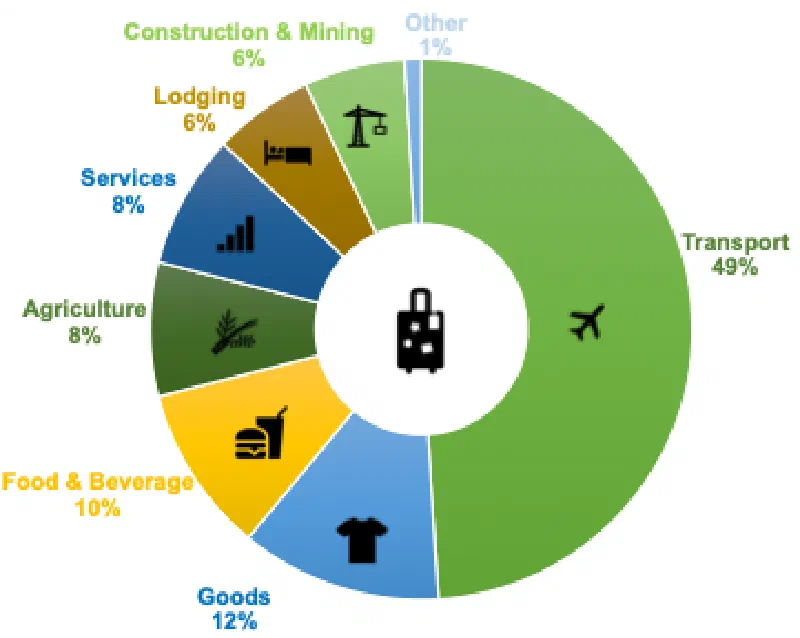
With the current heavy dependence on fossil fuels, travel for either business or pleasure results in emissions that affect atmospheric composition, resulting in potentially significant effects on climate. Tourism further adds to those emissions. The travel and tourism industries are significant contributors to climate, especially through global carbon emissions, with a carbon footprint estimated to be about 8% (and possibly larger) of total global emissions of greenhouse gases (Lenzen et al. 2018; World Travel and Tourism Council 2021; Huang and Tang 2021). Before the pandemic, global tourism had been growing 3-5% per year, outpacing the growth of international trade (Lenzen et al. 2018).
As shown in Figure 1, there are many different activities that contribute to the effects of tourism on climate. The carbon footprint includes the carbon emitted directly during tourism activities (e.g., fuel burned) and the carbon embodied in the commodities purchased, including accommodations, food, transportation, and shopping associated with the tourism. These analyses, such as that by Lenzen et al. (2018), consider the life cycle and /or supply chain emissions of tourism-related goods and services. It is found that transportation is the largest contributor, and that aviation is the largest contributor to the climate-related emissions from transportation, followed by cars and other personal vehicles.
Having shown that travel and tourism affect climate change, let’s turn to the effects of climate change on travel and tourism. From the beaches and environs of lush tropical islands to the hiking and skiing in mountainous regions, favorite vacation spots are increasingly at risk from the impacts of the changing climate. As the planet continues to warm, the increasing intensity of extreme weather and rising sea levels are affecting ecosystems and communities around the world. Beaches are shrinking, coral reefs are bleaching, and alpine ski resorts are finding themselves with longer periods without snow. As a result, the impacts of climate change are likely to increasingly affect travel and tourism directly, including effects on demand, interfering with the choice of destination and the period of the trip, or indirectly affecting the quality of the experience, adverse perception after some extreme event and insecurity about the destination related to safety as well as health.
The warming temperatures throughout the world, plus what this means for the increasing tendency for very hot days and heat waves, is changing the seasons for tourism. Warmer weather and more precipitation coming as rain instead of snow is tending to shorten the ski season both for downhill and cross-country skiing. It is affecting lakes and rivers, and ecosystems and biodiversity. These affect nature-based ecotourism as well as hunting and fishing activities. Also, if it is too hot, people will avoid these activities.
The increasing intensity of weather extremes is leading to more droughts in some tourism destinations, and more extreme precipitation and flooding in others. Impacts range from water scarcity to infrastructure damage and effects on hiking trails. Extreme wildfires, resulting from the warming climate leading to drier soils and forests, can destroy key tourism landscapes. The increasing intensity of tropical storms, e.g., hurricanes, can seriously affect major tourism areas, like those in the Caribbean or the west Pacific, and key cities for business and tourism like New Orleans.
The warming ocean and sea level rise are affecting coral reefs, including the Great Barrier Reef, affecting coastlines, and eroding beaches. In addition to many heavily populated areas, many popular tourist sites around the world are likely to be affected by the rising ocean. Sea level rise may result in the disappearance of many low-lying islands around the world may disappear, including the Maldives and many islands in the western Pacific.
Indirect impacts from climate change on travel and tourism include effects on spending, increasing insurance rates, and help drive political unrest and instability. Climate mitigation could affect the demand for travel and the destination choices. Diseases and pests, including concerns about viruses e.g., West Nile) and bacteria (e.g., dengue fever) may also affect travel and tourism.
Climate Impacts from Aviation
In 2017, airlines worldwide carried around 4.1 billion passengers. They transported 56 million tons of freight on 37 million commercial flights, averaging to over 100,000 flights per day. Every day, airplanes transport over 10 million passengers and around USD 18 billion worth of goods. Demand for air transport is expected to increase by an average of 4.3% per annum over the next 20 years. By the mid-2030s no fewer than 200,000 commercial flights per day are expected to take off and land all over the world.
Emissions by the aviation sector from the burning of fossil-based fuels currently account for about 2.4% of the total human-related emissions globally of carbon, especially as carbon dioxide (CO2), the most important heat-trapping gas driving the changes in climate (Lee et al. 2021). And that percentage is growing – aviation emissions grew by 5% per year between 2013 and 2018, and more growth is expected once the current pandemic has ended. Aviation emissions of water vapor that can form contrails (and also affect cirrus cloud formation in the upper troposphere) and emissions of nitrogen oxides that affect the natural levels of atmospheric ozone also affect climate (Brasseur et al. 2016; Lee et al. 2021). Particles resulting from emissions of soot and sulfur (the latter a fuel additive) can also affect climate as well as air quality. According to the European Union), if the global aviation sector were a country, it would rank in the top ten emitters (https://ec.europa.eu/clima/eu-action/transport-emissions/reducing-emissions-aviation_en.
While the current subsonic aviation sector is expected to continue to grow, the increasing demand for air travel, the aspiration for more intercontinental travel, and the desire for shorter flight times, have all contributed to a renewed interest in the potential development of civil aircraft that fly at supersonic speeds. As a result, various governments and companies around the world have been reconsidering development of supersonic aircraft for the business jet and commercial airline markets. Potential platform sizes, range from business jets to mid-size aircraft (50-80 passengers) to large aircraft (several hundred passengers). Fleets of hundreds to thousands of these supersonic business jets (SSBJs) and/or supersonic transport (SST) aircraft are likely necessary to make their development economically feasible.
Such supersonic aircraft would fly at higher cruise altitudes than the current fleet of subsonic aircraft, with their emissions primarily being in the upper atmosphere, at altitudes in the stratosphere close to where naturally high levels of ozone protects us all from harmful levels of ultraviolet radiation. The designs of these SSTs all use jet fuel, either conventional and/or biofuel-based versions, and the concerns about the environmental impacts of supersonic flights remain focused largely on the emissions of carbon dioxide, nitrogen oxides (NOx), and water vapor (H2O), as well as the aircraft takeoff and flight noise (including sonic boom). The direct emissions NOx and H2O directly into the stratosphere can then affect the concentrations of ozone. Although these aircraft can use twice as much fuel as subsonic aircraft, the overall effects of currently projected fleets of SSTs on climate are likely to be small, generally less than a 0.03°C change in globally-averaged surface temperature. Further study of these ozone and climate impacts is needed for fleets of specific supersonic aircraft as their designs are further developed over the next few years. Ongoing research to assess the impact on the public indicate that future low-boom supersonic aircraft designs could create significantly quieter sonic booms (thumps) that are much less annoying than those from conventional supersonic aircraft designs.
In addition, towards reducing their effects on climate, the aviation sector, in coordination with the UN’s International Civil Aviation Organization and the U.S. Federal Aviation Administration, is also committed to the development and deployment of sustainable aviation fuels (SAFs) to augment and diversify fuel supplies, reduce CO2 emissions, mitigate environmental impacts, and make aviation more sustainable. Biofuel-based SAFs can essentially eliminate CO2 emissions; the life cycle in the production of future SAFs will also need to not depend on fossil fuels. These SAFs also have low to negligible quantities of aromatic and sulfur compounds, thus leading to a significant reduction in particulate pollution that affect climate and air quality. However, these fuels would still lead to significant production of nitrogen oxides unless special effort is put into designing engines that reduce those emissions.
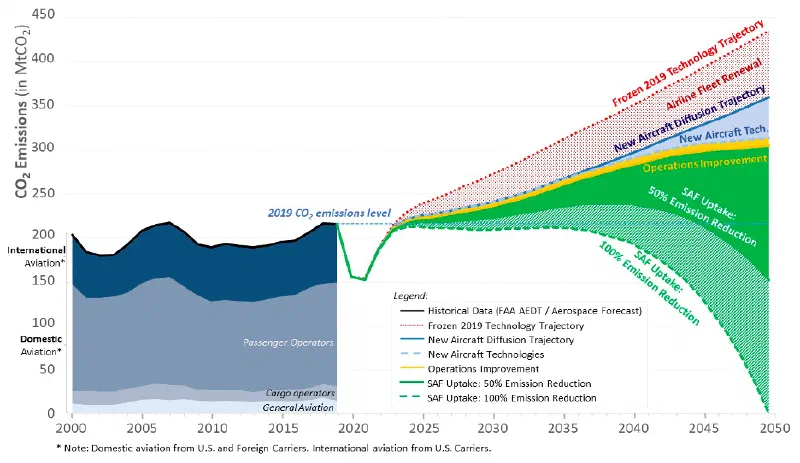
In 2009, the aviation industry committed to reducing emissions through both increased efficiency through technology, operations, and infrastructure improvements, and through the use of SAF, with the target of a 50% reduction in carbon emissions by 2050 compared to baseline 2005 levels. With the increasing focus on Net Zero emissions, this goal was recently changed to 100% reduction in carbon emissions by 2050 by a number of countries, including the United States (FAA, 2021; see Figure 2). Net zero carbon emissions reductions from commercial aviation would be achieved by 2050 through improvements in aircraft technology, improved flight operations, and the use of SAF. ICAO has expressed its support for this goal (https://www.icao.int/environmental-protection/Pages/LTAG.aspx). A transition of essentially all Jet A fuel to SAF will be essential to achieving this goal.
At this point, worldwide, there have been more than 360,000 commercial flights powered by various blends of SAF with conventional Jet A/Jet A-1, and 44 airports are regularly distributing blended SAF (ICAO, 2021). Any new fuel to be used in the aviation sector must be compatible with existing aircraft engines and fuel handling and storage infrastructure to be considered “drop-in” fuels. New fuel candidates must undergo a rigorous qualification and approval process prior to being certified.
Climate Impacts on Aviation
The changes in climate can also affect aviation. Extreme weather events are already known to have major effects on aircraft operations. Higher temperatures (and more heat waves) could especially slow down flight operations by affecting liftoff and airport pavements. Sea level rise and storm surge can affect airport facilities and operations. Climate variability, e.g., the location of the jet stream, storm development, convection, fog, visibility, and ceiling, can affect aviation route decisions.
The Future of Travel
The discussion above demonstrates the vulnerability of travel and tourism to the changing climate. Both mitigation and adaptation (resiliency) will be essential to the future of travel and tourism. Reducing emissions of carbon dioxide and other heat-trapping gases and particles associated with travel and tourism will be essential, not only to meeting the international goals to reduce future changes in climate, but also because 83% of global travelers think sustainable travel is vital (World Travel and Tourism Council 2021).
One of the side events at COP26 resulted in the Glasgow Declaration on Climate Action in Tourism with the objective to raise the climate ambition of tourism stakeholders and secure strong actions to support the global commitment to halve emissions by 2030 and reach Net Zero as soon as possible before 2050 (https://www.unwto.org/event/cop-26-launch-of-the-glasgow-declaration-a-commitment-to-a-decade-of-climate-action-in-tourism). The wording of the Glasgow Declaration was developed by 426 tourism organizations, companies and professionals (https://www.tourismdeclares.com) in consultation with a diverse range of travel and tourism stakeholders, including private sector actors, international organizations, NGOs and academia. More than 300 travel companies, tourism boards and countries have now signed the Declaration since COP26 (https://www.nytimes.com/2021/11/17/travel/travel-climate-change.html).
Travel and tourism will also have to adapt to and prepare for the unavoidable, negative effects of climate change. Extreme weather events, sea level rise, coastal erosion, biodiversity loss, destruction of infrastructure and property, disruption to cultural and natural heritage, along with increasing stress on basic natural resources, are all affecting travel and tourism (World Travel and Tourism Council 2021). In addition, the demand for tourism is sensitive to negative economic, environmental, and social impacts, resulting in tourism-dependent businesses, communities, livelihoods being increasingly vulnerable to the threat of climate change.
Nonetheless, there will be winners and losers as the climate continues to change. Travel will be affected. Tourism will not die, but it certainly will be changed, with new choices for vacations replacing others that are no longer viable or of interest.
Solutions are available that can reduce or stem the damage but planning needs to start soon. Adaptation is not a choice – our choice is whether to adapt proactively or respond to the consequences. Communities can be better prepared for the increasing likelihood for extreme heat or for the increasing likelihood of extreme precipitation events that can lead to flooding. Better forest management can reduce the spread of wildfires. Coastal communities can consider the protections that may be possible from the rising seas.
Conclusions
In general, minimizing future impacts and associated suffering to those in the travel and tourism industries, as well as those in many other sectors of society, we must achieve a lot of mitigation (reducing the emissions driving the changes in climate) and a lot of adaptation (becoming more resilient). We can slow climate change and reduce its magnitude, but it will take a concerted worldwide effort to greatly reduce the human-related emissions that are driving these changes. All nations need to significantly transition away from emissions associated with fossil fuels and they also need to be more proactive in protecting their forests and other natural resources because of their importance in storing carbon. A variety of analyses show this can be done without harming the economy. The clock is ticking. We need to face the challenges of addressing our changing climate. Meaningful solutions rest on technological, educational, social, and cultural actions. We need to come together to address what is clearly the biggest challenge of our time.
The travel industry can lead the way by aiming at Net Zero emissions by 2050. The industry can show their leadership by integrating climate considerations into their business strategy and developing a timeline with interim aims and targets, along with reducing their own emissions and reducing value chain emissions. The industry can also influence climate action in society and contribute where they can to community-wide action.
References
Brasseur, G. P., M. Gupta, B. E. Anderson, S. Balasubramanian, S. Barrett, D. Duda, G. Fleming, P. M. Forster, J. Fuglestvedt, A. Gettelman, et al., 2016: Impact of Aviation on Climate: FAA’s Aviation Climate Change Research Initiative (ACCRI) Phase II. Bull. Amer. Meteor. Soc., 97, 561-583.
European Commission, 2021: Reducing emissions from aviation. See https://ec.europa.eu/clima/eu-action/transport-emissions/reducing-emissions-aviation_en.
Federal Aviation Administration, 2021: United States 2021 Aviation Climate Action Plan. https://www.faa.gov/sites/faa.gov/files/2021-11/Aviation_Climate_Action_Plan.pdf.
Huang, T., and Z. Tang, 2021: Estimation of tourism carbon footprint and carbon capacity. International Journal of Low-Carbon Technologies, 16, 1040-1046; https://doi.org/10.1093/ijlct/ctab026.
ICAO, 2021: https://www.icao.int/environmental-protection/GFAAF.
Lee, D. S., D. W. Fahey, A. Skowron, M. R. Allen, U. Burkhardt, Q. Chen, … and A. Gettelman, :2021: The contribution of global aviation to anthropogenic climate forcing for 2000 to 2018. Atmospheric Environment, 117834. https://doi.org/10.1016/j.atmosenv.2020.117834.
Lenzen, M., Y.-Y. Sun, F. Faturay, Y.=P. Ting, A. Geschke and A. Malik, 2018: The carbon footprint of global tourism. Nature Climate Change, 8, 522-528.
World Travel and Tourism Council, 2021: A Net Zero Roadmap for Travel & Tourism. Proposing a New Target Framework for the Travel & Tourism Sector. London.
Disclaimer
The Earth Knowledge Blog is provided for general informational purposes only and is not meant to address specific climate conditions, risks, regions or time periods or to provide recommendations for any specific uses, actions or applications. You should not rely on the material or information in this Blog as the basis for any risk assessment, or to make any business, operational or other decision.